Relationship Between Atomic Radius And Ionization Energy Unique Creator Media #832
Activate Now relationship between atomic radius and ionization energy pro-level digital broadcasting. Free from subscriptions on our media hub. Immerse yourself in a extensive selection of hand-picked clips demonstrated in flawless visuals, the ultimate choice for superior watching viewers. With current media, you’ll always keep abreast of. Uncover relationship between atomic radius and ionization energy hand-picked streaming in vibrant resolution for a remarkably compelling viewing. Connect with our platform today to see members-only choice content with absolutely no charges, no recurring fees. Get frequent new content and dive into a realm of special maker videos made for choice media savants. Don't pass up never-before-seen footage—begin instant download! Witness the ultimate relationship between atomic radius and ionization energy one-of-a-kind creator videos with dynamic picture and editor's choices.
The increasing positive charge casts a tighter grip on the valence electrons, so as you go across the periodic table, the atomic radii decrease Down a group, outer electrons are farther from the nucleus and easier to remove. Figure 3 13 1 shows spheres representing the atoms of the s and p blocks from the periodic table to scale, showing the two trends for the atomic radius.
Ionization Energy vs. Atomic Radius by Joshua Wickline | TPT
The relationship between atomic radius and ionization energy is crucial in understanding the trends in the periodic table and predicting the behavior of elements in chemical reactions Decreases down a group, increases across a period By studying these properties, chemists can gain a deeper understanding of the fundamental principles of chemistry.
Generally speaking, atomic radius and ionization energy are inversely proportional to one another
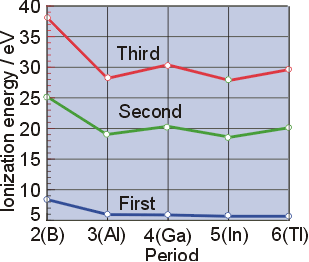
Figure 10.6d graphs the relationship between the first ionization energy and the atomic number of several elements. This scatter plot maps atomic radius against first ionization energy for all elements The pattern reflects coulomb's law Electrons farther from the nucleus experience weaker attraction and require less energy to remove.
Atomic radius decreases across a period and increases down a group Ionization energy exhibits the opposite trend It increases across a period and decreases down a group There is an inverse relationship between atomic radius and ionization energy
Electron configuration and nuclear charge are critical factors influencing these trends
Understanding these trends is essential for predicting. This completely depends upon the trends of the modern periodic table and the relationships within themselves (here, atomic radius and ionization energy) In general, we can say that this relationship is inversely proportional to each other i.e A t o m i c r a d i u s ∝ 1 i o n i z a t i o n e n e r g y complete answer
Let us define the terms and relationship between them This tutorial explains the concept, trends across periods and groups, and the atomic factors that influence it. Explain how trends in ionization energy, atomic/ionic radius, electron affinity, and electronegativity arise from electronic structure, coulomb's law, shielding, and effective nuclear charge (zeff). Okay, let's break down the relationship between decreasing atomic radius and increasing ionization energy

They're intimately linked, and understanding this connection is crucial in understanding how atoms behave and form bonds.
Visual aids help in understanding the relationship between atomic structure and periodic trends Atomic structure and electron configuration atomic radius and ionization energy atomic radius refers to the size of an atom, which generally decreases across a period and increases down a group due to electron shielding. This activity explores the relationship between atomic radius, ionization energy, and electron affinity It encourages discussion and investigation of trends in these properties across groups and periods in the periodic table, emphasizing the effects of atomic size on electron interactions.
Atomic radius decreases across a period due to increased nuclear charge, electron shielding, and effective nuclear charge, affecting ionization energy and electronegativity in periodic trends. As z_eff increases across a period, the attraction between the nucleus and electrons increases, leading to a decrease in atomic radius Explore periodic trends in atomic radius, ionization energy, and electron affinity through interactive simulations and data analysis. Ionization energy and electronegativity both tend to increase across a period and decrease down a group, reflecting the increasing nuclear charge and decreasing distance of valence electrons from the nucleus

This relationship indicates that elements with high electronegativity also require more energy to remove an electron, highlighting their strong attraction for electrons.
It explains many periodic trends, including ionization energy, electronegativity, and atomic radius Across a period, zeff increases because the number of protons increases while core electrons remain constant. Study with quizlet and memorise flashcards containing terms like what trend describes the change in atomic radius as you move down a group in the periodic table?, how does atomic radius change as you move from left to right across a period?, what happens to the size of an atom when it gains electrons to form an anion What is the significance of the atomic mass on the periodic table
It reflects the weighted average of isotopes, hence the decimal values What is the relationship between isotopes of an element They have the same number of protons but different numbers of neutrons Give an example of two isotopes of carbon

The properties include atomic radius, first ionization energy, electron affinity, and electronegativity
Some values are provided, while others are missing (indicated by '?'). Properties such as ionization energy, atomic radius, and electron affinity exhibit periodicity, meaning they show predictable patterns as one moves across or down the periodic table. Understanding the distribution of electrons in orbitals and the significance of core and valence electrons Key trends in atomic radius, ionization energy, and electronegativity across periods and groups
Insights into molecular geometry, bond types, and polarity based on electronegativity differences. Arrange the following in order of increasing atomic radius A) na, mg, al, si b) f, cl, br, i problem 5 Explain why the first ionization energy of magnesium is higher than that of sodium.

•ionization energy (energy needed to remove an electron) trend