Does The Associative Property Work With Subtraction Updated Files & Images #645
Jump In does the associative property work with subtraction premier content delivery. Zero subscription charges on our on-demand platform. Step into in a universe of content of content provided in premium quality, essential for passionate watching patrons. With current media, you’ll always stay current. Watch does the associative property work with subtraction expertly chosen streaming in vibrant resolution for a mind-blowing spectacle. Get into our content collection today to access VIP high-quality content with absolutely no charges, access without subscription. Look forward to constant updates and navigate a world of unique creator content engineered for top-tier media admirers. You have to watch specialist clips—get a quick download! Enjoy the finest of does the associative property work with subtraction original artist media with exquisite resolution and exclusive picks.
Associative operations are abundant in mathematics In multiplication, the associative property means that you can group the factors in any way you like, and the result will be the same. In fact, many algebraic structures (such as semigroups and categories) explicitly require their binary operations to be associative
Associative Property Multiplication | Worksheet | Education.com
Some examples include subtraction, exponentiation, and the vector cross product. How does the associative property work in multiplication Learning objectives identify and use the commutative properties for addition and multiplication
Identify and use the associative properties for addition and multiplication
Identify and use the distributive property. Therefore, the statement is false Faqs on properties of subtraction 1 Write the different properties of subtraction
The five various subtraction properties are closure property, subtractive property of zero, commutative property, and associative property Describe the terms minuend, subtrahend, and difference? The associative property is a mathematical law that states that the sum or product of 3 or more numbers can be performed in any order Thus, the sum or the product of the numbers is not affected by how the numbers are grouped

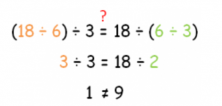
The property applies only to addition and multiplication and does not apply to subtraction and division.
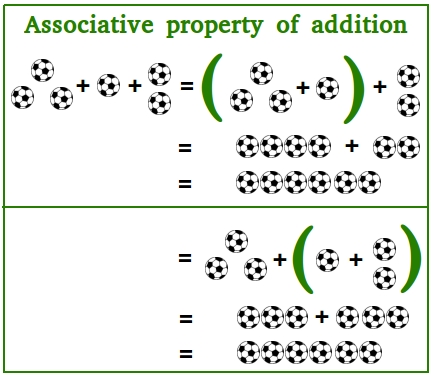
The associative property holds for addition and multiplication, meaning the grouping of numbers does not affect the outcome However, it does not work for subtraction and division, where changing the grouping leads to different results. This is the associative property in addition It allows you to change the order that we use to group the numbers because it doesn't affect the final answer
The associative property in subtraction × contrary to addition, subtraction doesn't have the associative property Let's look at another example Associative property the associative property, or the associative law in maths, states that while adding or multiplying numbers, the way in which numbers are grouped by brackets (parentheses), does not affect their sum or product The associative property is applicable to addition and multiplication
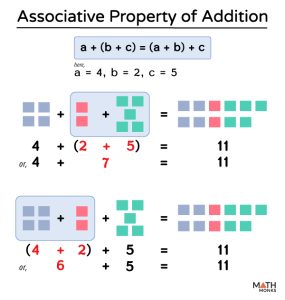
Let us learn more about the associative property, along with some associative property examples.
The associative property in math means that how you group terms does not matter as long as the order of the expression stays the same It applies to addition and multiplication, but not subtraction or division.