Name The Relationship Complementary Linear Pair Or Vertical Full Media Package #904
Jump In name the relationship complementary linear pair or vertical superior broadcast. On the house on our content hub. Experience the magic of in a ocean of videos of shows put on display in 4K resolution, the ultimate choice for top-tier watching fanatics. With the latest videos, you’ll always be informed. Seek out name the relationship complementary linear pair or vertical preferred streaming in retina quality for a deeply engaging spectacle. Become a part of our entertainment hub today to get access to exclusive prime videos with completely free, no recurring fees. Get frequent new content and navigate a world of indie creator works built for deluxe media junkies. Take this opportunity to view singular films—download now with speed! Witness the ultimate name the relationship complementary linear pair or vertical exclusive user-generated videos with brilliant quality and preferred content.
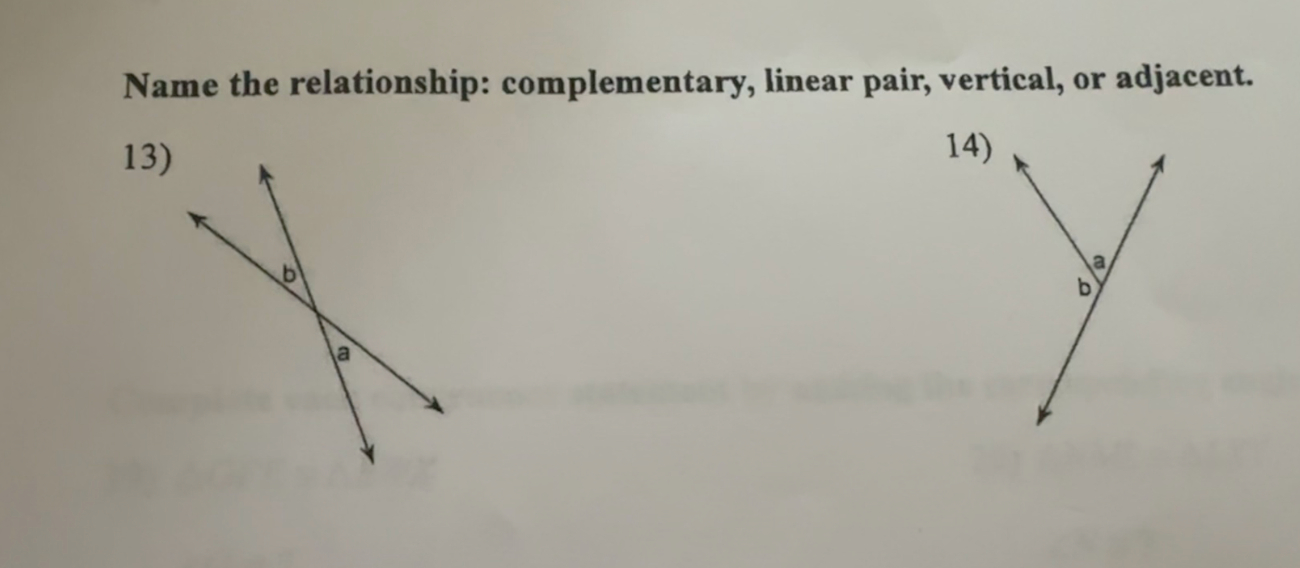
In geometry, key relationships between angles include linear pairs, adjacent angles, complementary angles, and vertical angles Understanding these relationships is crucial in geometry. A linear pair consists of adjacent angles that sum to 180 degrees, while complementary angles sum to 90 degrees
Angle Pair Notes - Complementary, Supplementary, Linear Pair, Vertical
Vertical angles are formed when two lines intersect and are always congruent to each other. Each relationship is defined by specific properties based on the angles' measures and positions *complementary* angles add to 90 degrees
*supplementary* angles add to 180 degrees
*vertical* angles are the 'opposite' angles formed by two intersecting lines, and have equal measures ©p m2k0u1p1g zksuptpaa gsbodfetgwqa4rgep 5lslmcb.p y larlqlb 4rni7grhfths8 hrje3szeortvlesdv.p d nmbaldneh fwxihtehy wimnwfviyn8iktfej yg9edoqmzeltarkyx.3 14) worksheet by kuta software llc The relationships between the angle pairs are identified based on their definitions
Adjacent angles share a vertex and side, complementary angles add up to 90 degrees, vertical angles are opposite and congruent, and a linear pair forms a straight line (180 degrees). Geometry worksheet focusing on angle pair relationships Complementary, linear pair, vertical, and adjacent angles Practice identifying and calculating angle measures.
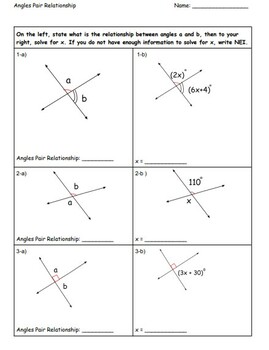
2 determine the relationship between angles ad and bcd
Since they are formed by the same line and are adjacent to each other, they share a common vertex and side 3 conclude the relationship Angles that are adjacent and formed by intersecting lines are classified as a linear pair if they are supplementary (sum to 180 degrees) Two or more angles can be related, if certain conditions are met Here, we will learn different types of angle relationships
(i) congruent angles (ii) vertical angles (iii) complementary angles (iv) supplementary angles (v) adjacent angles (vi) adjacent angles in parallelogram (vii) linear pair (viii) corresponding angles (ix) alternate interior angles (x) alternate exterior angles (xi. The relationships in question include complementary angles, which sum to 90 degrees Linear pairs, which sum to 180 degrees Vertical angles, which are opposite angles and congruent

And adjacent angles, which share a common vertex and side